Easy Tips to Help Nurture Your Child’s Literacy From Birth to First Grade
Easy Tips to Help Nurture Your Child’s Literacy from Birth to First Grade
In Reading for Our Lives, award-winning journalist and literacy advocate, Maya Payne Smart, provides a clear step-by-step guide to helping your child thrive as a reader. It’s a handy blueprint that gives parents easy, immediate and accessible ways to nurture language and literacy development from birth to early-elementary school.
As a busy career mom, Smart understands a parent’s struggle to find time in the day to help their child with literacy success, saying, “These are principles any parent can remember and apply with ease during long, busy days with young children.” Below are excerpts from Reading for Our Lives on techniques you can adopt right away.
1. Point to words in the world for relevance
Literacy building doesn’t have to take place at only bedtime, says Smart. Studies provide evidence that infants and young toddlers benefit from conversations in the present while we point and gesture to label objects in our immediate surroundings. You can use this technique wherever there is print. Cereal boxes and street signs are just a couple of examples.
2. Keep the conversations going
Look for opportunities to elaborate on what you’re talking about. While reading, you can bring book content into the realm of everyday life by linking characters and plot to things the child has experienced. “Look! It’s raining in the picture. It’s raining outside our window too.” A back-and-forth exchange is critical to brain growth from ages birth to three.
3. Ask questions
Try asking questions about a scene unfolding in real life or within the pages of a book you’re reading, like “What’s that? Do you see the bird?” A study showed that the number of questions parents ask during shared book reading with 10-month-old infants predicted language skills eight months later. “Simply put, conversation spurs brain development,” stated Smart.
4. Make it personal
Make lessons personally meaningful for your child. Sometimes it’s as simple as teaching the child the letters in their first name, making up songs and stories featuring their pets or choosing vocabulary words from their favorite books. When Anna sees the letter A and says, “That’s my letter!” She’s owning it and identifying with it. In the same vein, if you start a story centered around a sport they play, they’ll make a personal association with it, according to Smart.
5. Praise the Process
Cheer on your child’s hard work and determination. Instead of giving generic praise like, “You’re so smart,” say specifically what you liked about how they learned, not just the results. Try “Good job working hard” instead. Researchers have found evidence that when parents praise kids’ efforts in the learning process—not the outcomes—it impacts their belief that they can get smarter if they work at it.
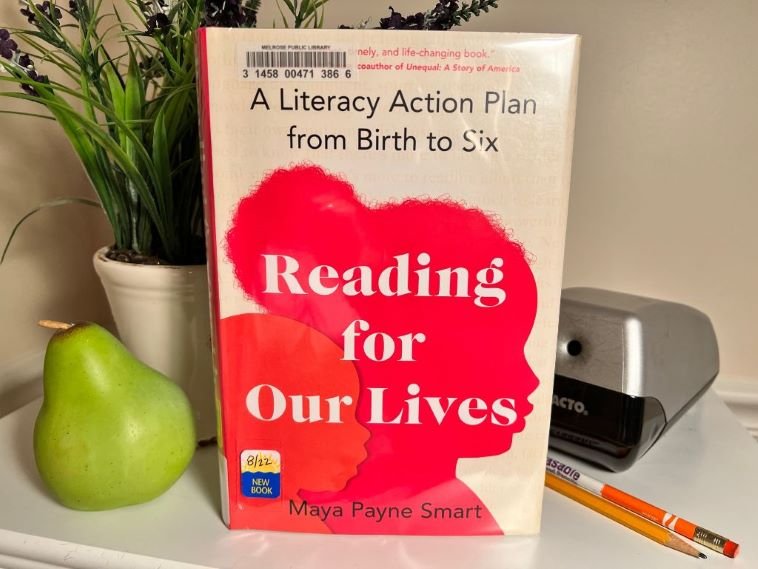
Published by Avery, an imprint of Penguin Random House, 2022
Smart stresses that there’s more to reading aloud and reciting words on a page. “The parents’ job in the beginning is not to teach reading but to nurture its long-term development through active attention, book sharing and caring conversations,” she notes. “Think of these as your own ABCs.”
Reading for Our Lives walks parents and guardians through early-education literacy skills, how they develop, when to nurture them and milestones by age group. Handy journal prompts are sprinkled throughout the book for parents to record observations. Specific tools are provided that you can integrate at home to foster literacy development and phonological awareness.